Advertisement
Photo provided by: Nobels

__________________________________________________________________________________
The Nobels MOD‑mini is a compact stereo modulation pedal designed for guitarists seeking versatility in a small footprint. Despite its miniature size, it packs three classic modulation effects—Tremolo, Phaser, and U‑Vibe (Uni‑Vibe)—into a single pedal. Players can select between these modes using a simple switch, making it a convenient solution for those who want multiple textures without cluttering their pedalboard. Its durable metal housing and glow-in-the-dark knobs also make it stage-ready, providing both robustness and visibility in low-light settings.
One of the key strengths of the MOD‑mini is its stereo capability, which allows for an immersive, spacious sound. It also features tap tempo control, activated by holding down the footswitch, and selectable true-bypass or buffered bypass, offering flexibility for different rigs. These features, combined with its compact design, make it ideal for players with limited pedalboard space or those who travel frequently and need a versatile yet portable modulation solution.
The pedal excels at providing a broad range of modulation textures suitable for various genres. Whether you want subtle vintage-style tremolo, a swirling Uni‑Vibe effect, or rhythmic phaser pulses, the MOD‑mini delivers. This versatility makes it useful across rock, funk, blues, ambient, indie, and jazz styles. Its built-in functionality allows players to quickly set up and achieve musical modulation effects without the need for multiple separate pedals.
However, there are some trade-offs to consider. The compact size limits the number of control parameters, offering only essential adjustments for rate, width, and mix. While the pedal uses a digital modulation engine with analog-style voicing, purists seeking purely analog circuitry may notice a difference in tonal character. Additionally, the MOD‑mini requires an external 9 V DC power supply, as it does not operate on batteries, and dedicated individual pedals might offer deeper tonal control than this all-in-one solution.
Overall, the Nobels MOD‑mini is ideal for guitarists who value versatility, portability, and simplicity. It provides three essential modulation effects in one compact, stage-ready pedal, making it a compelling choice for gigging musicians or anyone looking to add modulation without cluttering their setup. For those who prioritize maximum depth and analog purity, separate full-size pedals might still be preferable, but the MOD‑mini strikes a strong balance between convenience and musicality.
How MOD‑mini compares with similar pedals
The Zoom MS‑70CDR is a very different beast compared with the MOD‑mini: it’s a multi‑effects unit offering modulation and many other effects (delay, chorus, reverb, etc.), and can run multiple effects simultaneously. For a player who wants an all‑in‑one solution — modulation, delay, chorus, maybe even reverb all on one pedal — the MS‑70CDR is hard to beat in terms of sheer flexibility and value. However, because it’s broader in scope, it tends to have more complexity (menus, preset management, maybe a bit more latency or “digital character”) than a dedicated modulation pedal like the MOD‑mini. So if you want a simple “set‑and‑forget” modulation stompbox, MOD‑mini is often more straightforward and focused.
NUX Mod Core Deluxe (multi‑modulation pedal)
The NUX Mod Core Deluxe offers a range of modulation types — more than just tremolo, phaser, or vibe — giving you more tonal palette if you want to experiment or switch styles often. Compared to MOD‑mini, the NUX might offer more modulation variety and potentially deeper controls for shaping effects. On the flip side, that breadth may come with a larger footprint, slightly higher complexity, and possibly more “menu digging” than the compact, hands‑on simplicity of MOD‑mini. If you value maximum variety, NUX could win; but if you want compact size and intuitive controls, MOD‑mini stays appealing.
Sonicake 5th Dimension Digital Mod Pedal (budget all‑in‑one modulation effects)
Sonicake’s 5th Dimension pedal is a budget‑oriented multi‑mod unit that gives you many effects in one box. Its lower price point can make it attractive if you’re on a budget but still want modulation versatility. However, compared with the MOD‑mini, it may not have the same build quality, stereo I/O flexibility, or “true/buffered bypass + tap‑tempo + stereo” feature set that MOD‑mini offers. In short: Sonicake might be good for experimentation or casual playing, but MOD‑mini tends to offer a more polished, performance-ready feature set — especially useful for live gigs or serious rigs.
In short: Who should pick MOD‑mini vs Who should pick alternatives
Choose MOD‑mini if you want a compact, easy-to-use, high‑quality modulation pedal for tremolo, phaser or vibe — ideal for gigging, pedalboard‑efficient setups, or players who want classic modulation sounds without complexity.
Choose a multi‑effect or multi‑mod pedal (like Zoom MS‑70CDR or NUX Mod Core Deluxe) if you want maximum versatility, multiple effects beyond modulation, or lots of sonic variation — ideal for experimental players, home studio users, or anyone needing a “Swiss‑Army knife” pedal.
"The Nobels MOD‑mini proves that great modulation doesn’t need a large footprint. Tremolo, Phaser, and Uni‑Vibe effects are all punchy, musical, and instantly usable, making this compact pedal a must-have for gigging guitarists and pedalboard minimalists alike."
— Guitar Thrills Magazine
Where does it fit in your typical signal chain or rig?
In a recording chain, the Nobel Mod Mini can be positioned directly after a microphone preamp to introduce controlled harmonic enhancement before dynamic processing. Its analog gain structure adds a low-order harmonic series that thickens midrange material without significantly altering transient response. This positioning allows compressors downstream to react more musically due to the smoother waveform introduced by the module. As an instrument front-end, the Mod Mini provides impedance-matched buffering and light saturation that stabilizes input level variations. Its coloration circuit enhances upper-mid harmonics around the 1.5–4 kHz region—useful for electric guitars and synths requiring presence. When placed before pedals or effects processors, it conditions the signal, reducing noise floor inconsistencies and increasing perceived clarity.
In modular synth environments, the Mod Mini works as a harmonic insertion module between oscillators and filters. Because it behaves predictably under voltage-controlled drive, it can add nonlinearities that create subtle sidebands without collapsing the stereo field or introducing unstable DC offsets. This makes it ideal for warming digital oscillators or providing analog grit to clean VCA outputs.
For live rigs, the Mod Mini can be inserted between a DI box and the mixing console. Its low-noise circuitry maintains headroom even at high SPL environments, ensuring that harmonic coloration stays consistent. The slight compression effect created by its soft-knee saturation helps stabilize dynamics before they hit FOH compressors, giving a more mix-ready signal on stag
During sound-design workflows, the Mod Mini excels as a texture-shaping tool. When driven, its saturation introduces a nonlinear curve that selectively emphasizes odd harmonics, making dull recordings feel more detailed. Placed before granular processors or convolution reverbs, it improves signal density, giving downstream effects richer material to work with. Voiceover and spoken-word chains benefit from placing the Mod Mini after a clean preamp but before EQ. The mid-band focus and gentle high-frequency roll-off reduce sibilance and add body. Because the module does not significantly increase noise, it is safe to use early in the chain, allowing EQ and compression to interact with a smoother, more harmonically complex voice signal.
On mix buses, the Mod Mini can be used as a parallel or full-insert harmonic blender. Its symmetrical clipping characteristics preserve low-frequency phase while adding upper-band density. When used on drum buses, it increases transient density, helping kick and snare sit cohesively without altering stereo imaging. On vocal buses, it creates a forward tone that reduces the need for aggressive EQ boosts
Mastering engineers can deploy the Mod Mini as a gentle harmonic pre-processor at the start of the chain. At low drive settings, it lifts perceived loudness by adding 2nd- and 3rd-order harmonics without introducing noticeable distortion. This helps downstream limiters operate more efficiently, often resulting in cleaner peaks and reduced pumping artifact
In hybrid analog-digital workflows, the Mod Mini serves as a coloration insert during stem re-amping. Routing stems out of a DAW into the module adds organic harmonic spread that plugins cannot fully replicate. Because its frequency response remains stable across drive levels, the resulting tone is predictable and repeatable—ideal for parallel stem coloration.
For experimental or modular performance setups, the Mod Mini can be intentionally pushed past its nominal operating range to explore complex nonlinear behavior. At high drive, its transfer curve produces controlled waveform folding and soft clipping, generating new harmonic structures without devolving into unpredictable noise. This makes it a precise yet expressive tool for creative signal disruption.
A RECAP OF WHAT YOU MIGHT HAVE MISSED
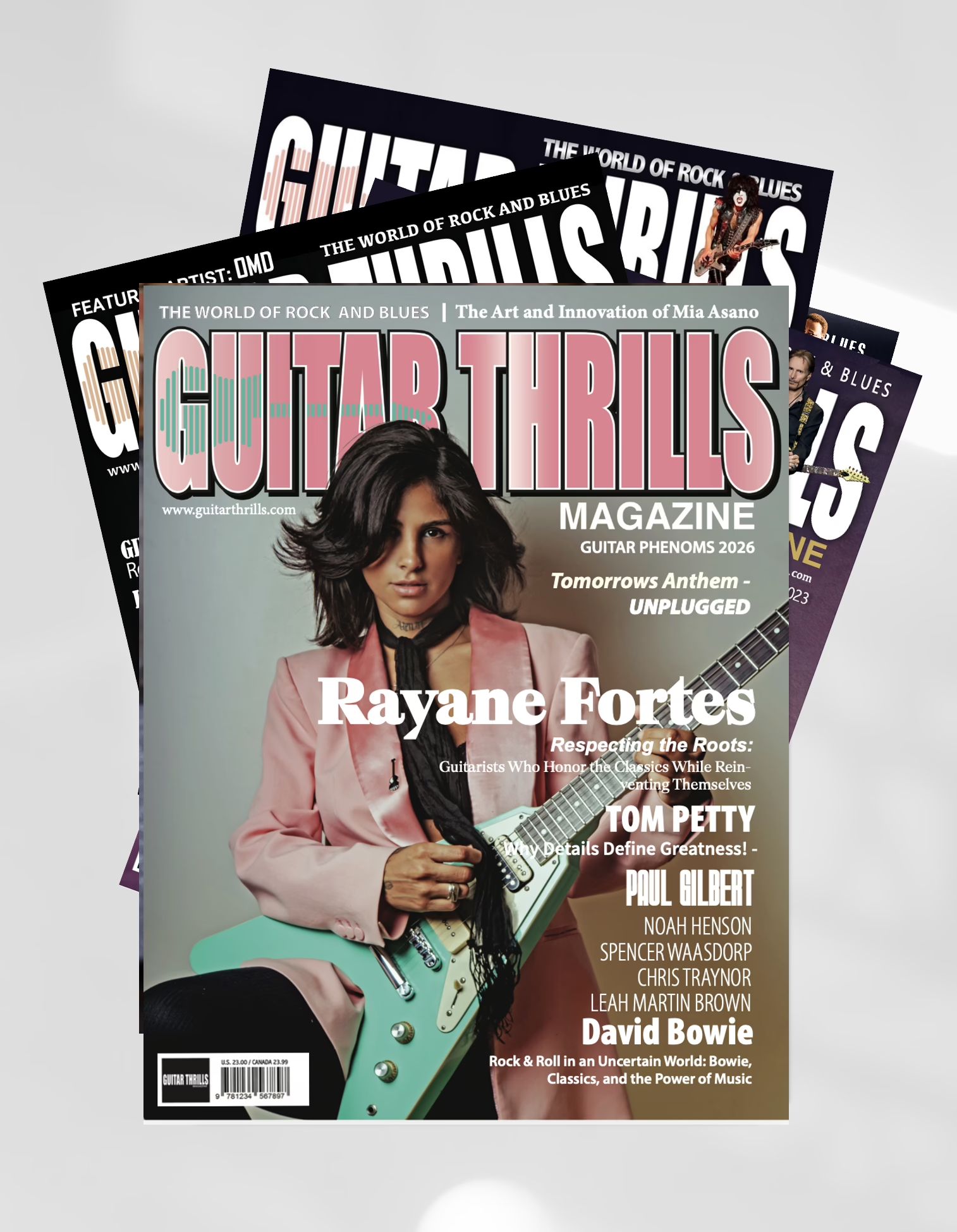 Download Digital Copy