Advertisement
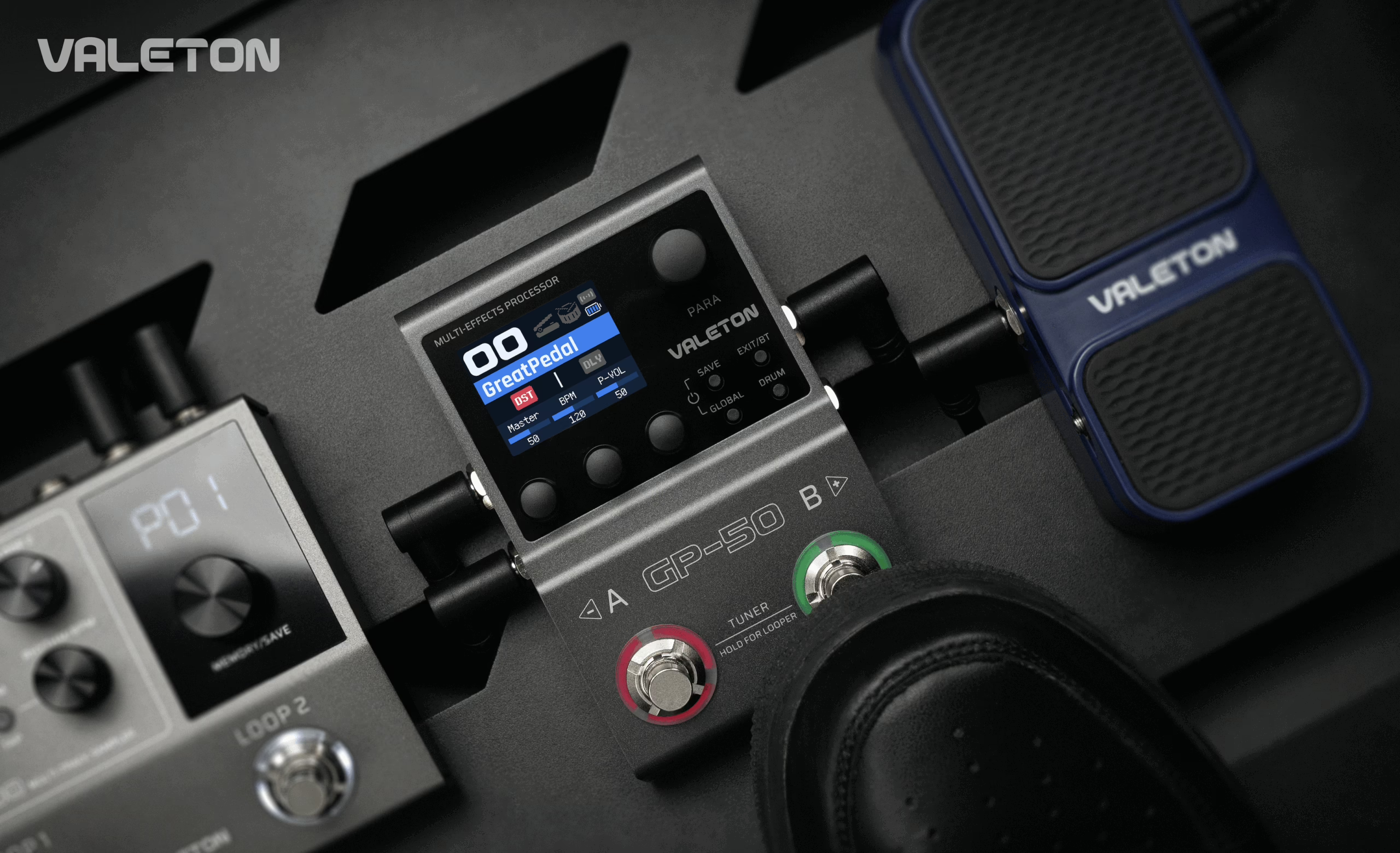
Photo provided by: Valeton and are subject to copyright laws

__________________________________________________________________________________
Valeton’s rise has helped shift expectations in the effects-pedal market. Their success signals that many players prefer versatile, compact, and affordable solutions over bloated rigs with redundant pedals. This trend likely encourages other brands to innovate similarly — offering multi-effects, modeling, and flexible connectivity in smaller, cheaper packages.
As a result, the standard for what constitutes a “complete rig” has broadened: instead of pedalboards + amps + cabs, many guitarists now see a compact multi-FX modeler as a legitimate core of their setup. That changes the economics and logistics of playing, especially for indie musicians, bedroom players, solo artists, and gigging bands on a budget.
Valeton, in this sense, has played a meaningful role in democratizing access to high-functionality guitar effects — helping reshape what a “modern pedalboard” can look like.
The Valeton difference lies in combining power, flexibility, accessibility, and portability — giving guitarists serious tone-shaping capabilities without demanding bulky rigs or steep costs. For many players, that’s not just “another pedal” — it’s a paradigm
Insight into the Valeton GP-50 An official game changer for mutli - effects pedals
The Valeton GP‑50 is part of Valeton’s new “GP” series, announced in late 2025, alongside the GP‑150 and GP‑180. It is designed as a compact multi-effects workstation, offering guitarists a combination of amp modeling, cabinet IR support, effects, and preset storage. Compared with its predecessor, the GP‑5, the GP‑50 features a larger screen, more knobs and encoders, and two footswitches instead of one, making navigation and live adjustments more convenient. It also reportedly offers a rechargeable battery option, enhancing portability for gigging and travel.
In terms of features, the GP‑50 is expected to retain the core capabilities that made the GP‑5 popular. These include effects processing, amp modeling, cabinet IR loading, preset and patch storage, and support for Neural Amp Modeling (NAM). Additional features like a built-in looper and presumably improved interface ergonomics suggest that the GP‑50 aims to be an all-in-one rig capable of handling rehearsal, recording, and live performance situations without needing a full pedalboard or traditional amp setup.
The GP‑50 is especially appealing to players seeking portability and convenience. Its improved interface and additional controls are designed to reduce the programming difficulties often associated with smaller multi-effects pedals. The ability to quickly adjust presets and tweak parameters during live performance makes it an attractive option for guitarists who need a flexible rig that works well in a variety of settings, from home practice to gigs.
While the GP‑50 likely improves ergonomics and convenience, we have noted that its core sound engine may be similar to the GP‑5, meaning tonal improvements might be subtle rather than dramatic.
Overall, the GP‑50 seems best suited for guitarists who want a compact, versatile, all-in-one solution for effects, amp/cab modeling, and preset management. It is particularly useful for those who need portability, flexibility, and quick live adjustments. Players seeking top-tier studio-quality tone or highly complex routing may want to compare the GP‑50 with higher-end multi-effects units or modular pedalboard setups before committing.
Here’s a side‑by‑side comparison between Valeton GP-50 and Valeton GP-5
Core Features — What GP‑5 already gives you
The GP‑5 is a compact, budget‑friendly multi‑effects + amp/IR/NAM‑loader pedal. Key specs:
In short: GP‑5 offers a full multi‑FX/IR/NAM/amp‑sim platform in a small form factor — great for bedroom playing, rehearsal, casual recording, or as a compact alternative to a pedalboard + amp + cab.
What GP‑50 adds / improves (vs. GP‑5)
Improvements / new form factor / ergonomics / features:
In other words: GP‑50 looks like an attempt to move beyond the “pocket‑pedal” limitations of GP‑5 — giving more control, flexibility, and convenience, maybe leaning closer to a “mini‑floor‑station” vibe while keeping portability.
Guitar Thrills Magazine believes that this is a true upgrade over GP‑5. The GP‑50 may use the “same backend” as GP‑5, simply with a different form factor/interface, meaning sound quality and NAM/IR processing could be largely similar.
Who each model is “for” — and which might be better for you
Choose GP-5 if you want:
Choose GP-50 if you want:
Portability + usability: a middle ground between pocket‑pedal and full pedalboard/floor‑station.
More hands‑on control, easier editing/patch‑management, and enough flexibility for live use — thanks to bigger display, more controls, dual footswitches.
A more “complete” mini‑floor‑station: effects, amp/IR/NAM, looper, easy switching — potentially enough to substitute for a small rig.
Overall Discovery
The GP‑50 represents a clear and meaningful step up in usability and flexibility compared with smaller, more limited multi‑effects pedals. Its larger interface — more knobs/encoders, a bigger display, and dual footswitches — makes building, editing, and switching patches far easier. This alone transforms the GP‑50 from a compact “practice pedal” into a serious, gig‑ready multi‑FX rig: dialing in tones live or in the studio becomes practical rather than fiddly.
Moreover, GP‑50 delivers the full range of features you expect from a modern all-in-one unit — multiple effects, amp and cabinet modeling (IR/NAM support), patch storage, and (reported) looper/rechargeable‑battery options — while still preserving portability. That balance of power, versatility, and convenience means you get a “complete rig in a box.” Buying a GP‑50 lets you cover rehearsals, recording sessions, live gigs, and travel setups with one device — no need for a large pedalboard or multiple separate pedals.
Finally, given what you pay for the GP‑50, you get excellent value: a high‑flexibility, relatively compact unit that frees you from the cost, complexity, and space‑needs of many discrete pedals or floor‑station systems. For players who want something they can plug in and go — yet still have enough power and control to sound good in varied contexts — GP‑50 is a smart, future‑proof
A RECAP OF WHAT YOU MIGHT HAVE MISSED
 Download Digital Copy